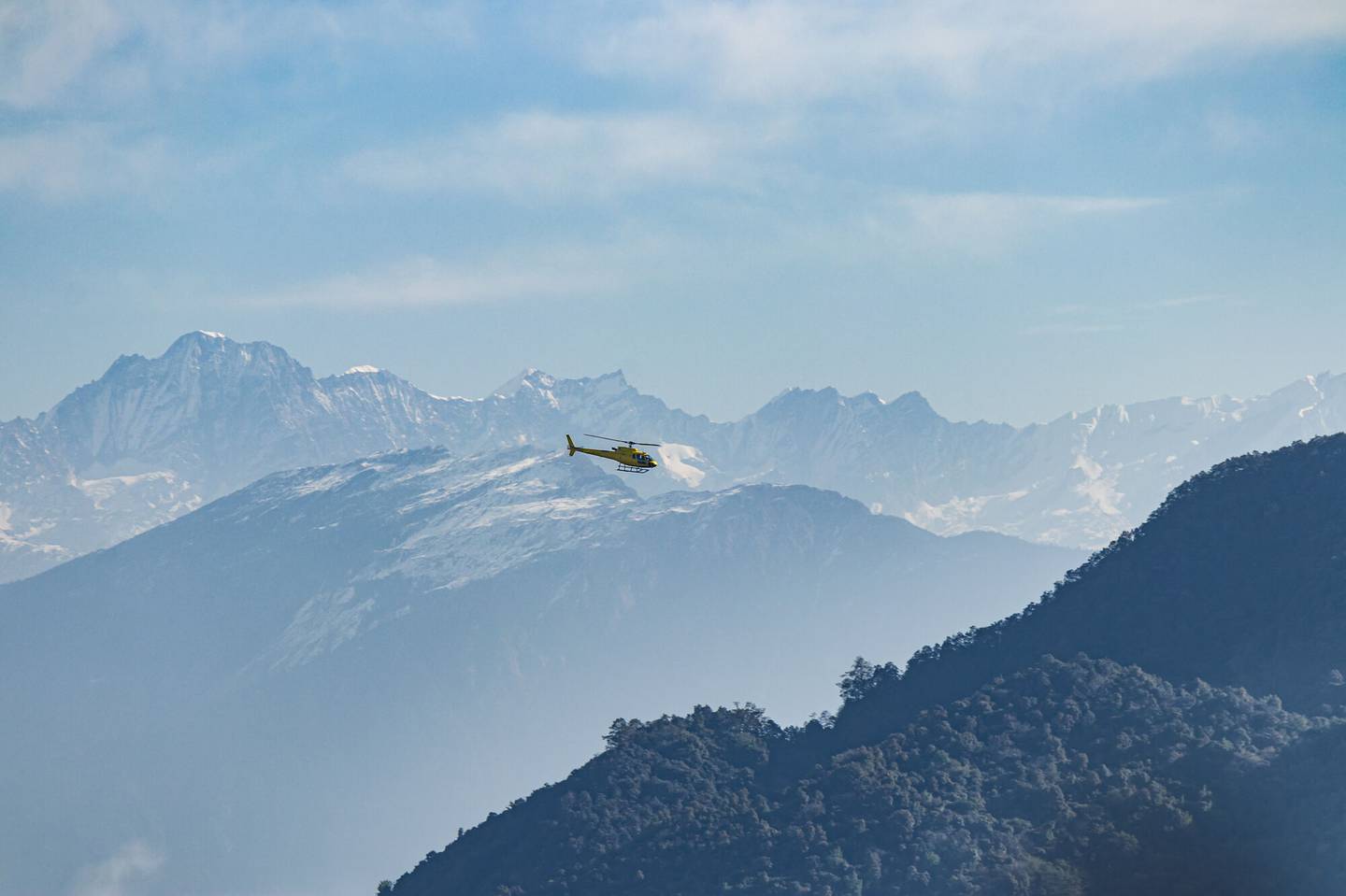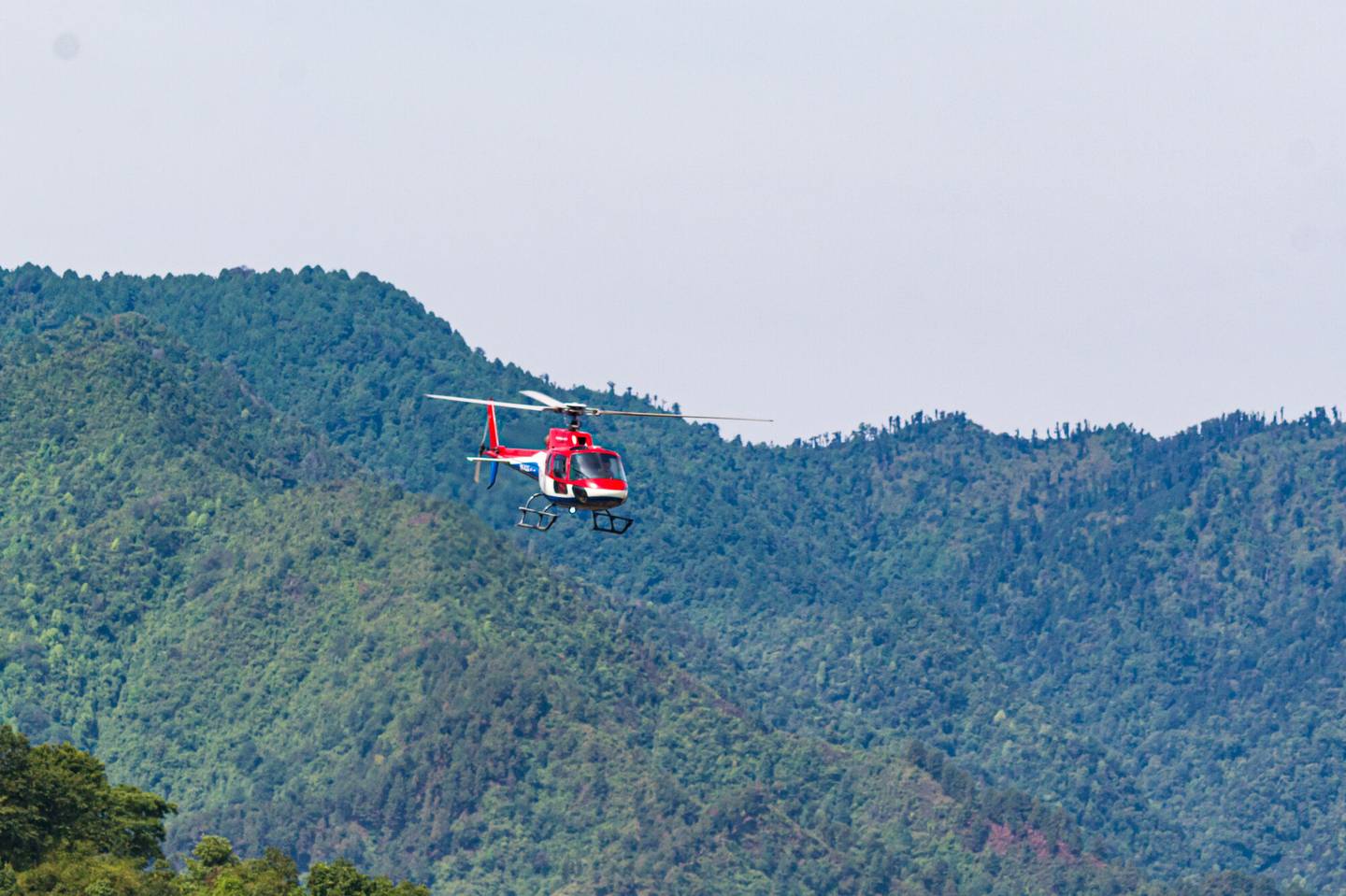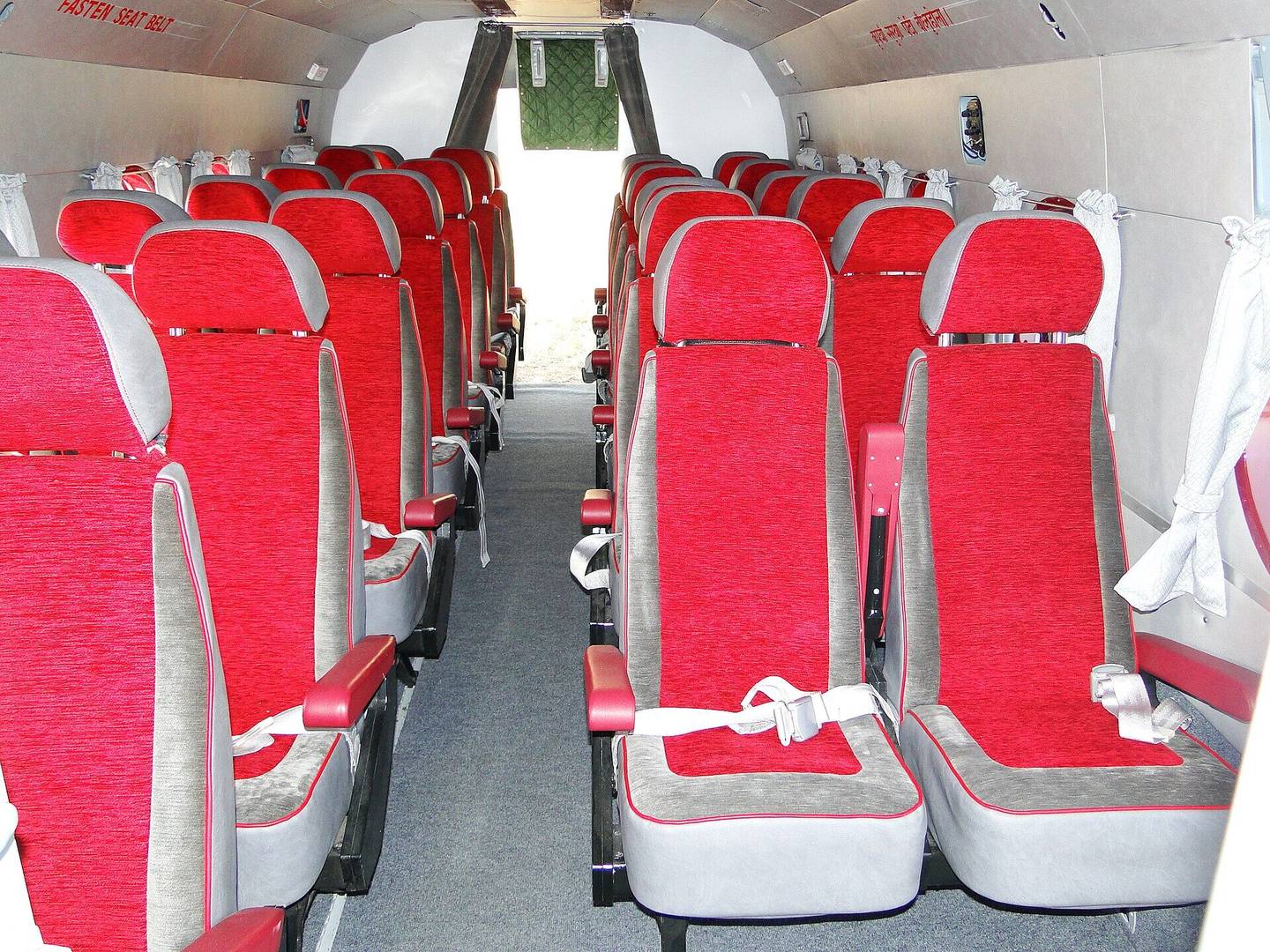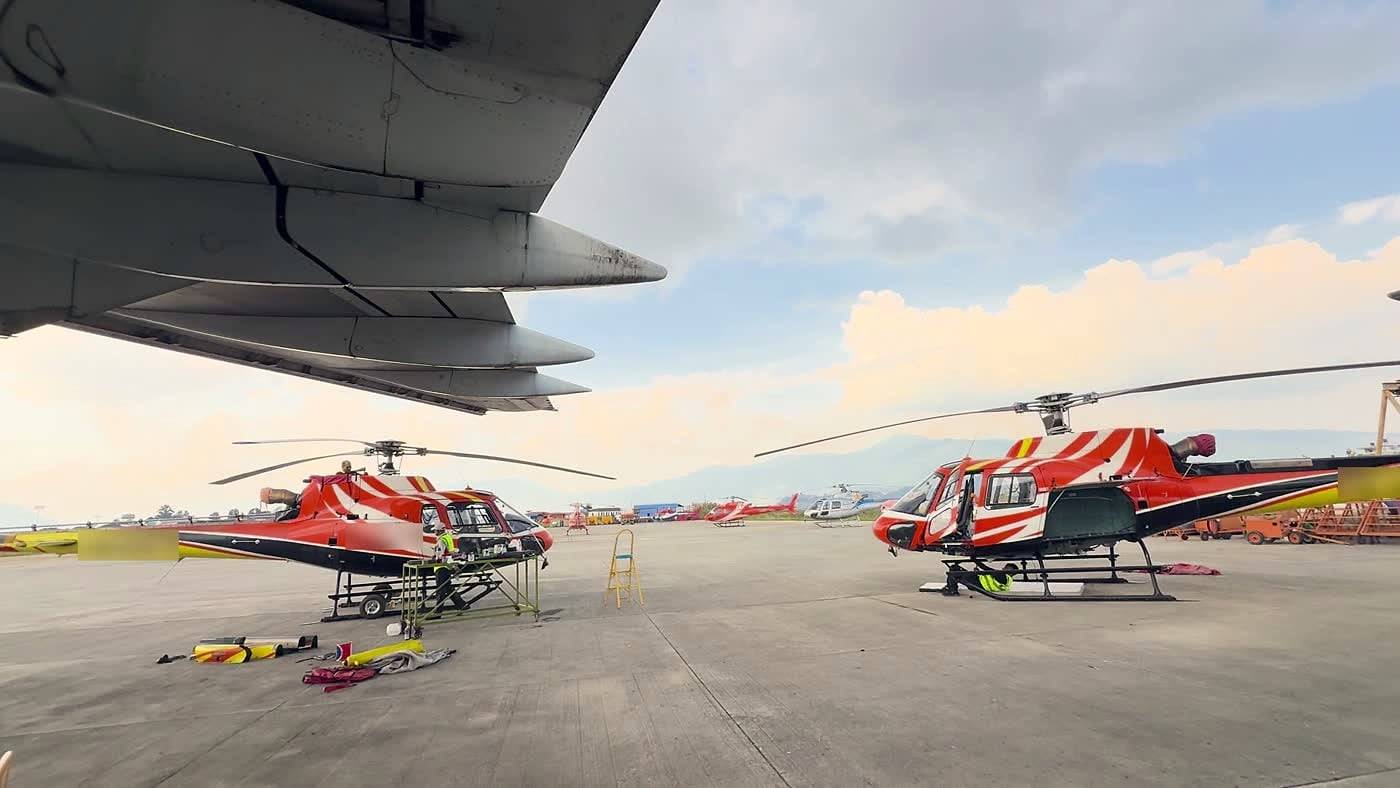

A helicopter price in Nepal takes one of three shapes: a per-seat fare on a packaged flight, an hourly rate for the whole aircraft, or a fixed price per sector. Charter is billed in block time, not flying time. Airport charges, taxes and permits may or may not be inside it. The current range is on our private helicopter page.
Most of that flying starts at Kathmandu's Tribhuvan International Airport, 1,338 m above sea level and the base for most of Nepal's helicopter fleet. The eastern work runs to the Khumbu through Lukla at 2,845 m, and the western work runs through Pokhara. This page is the price question across all of it: what the number is built from, why two published figures for the same flight disagree, and which of them you are reading. What one particular tour costs belongs to that tour's own page.
What are you actually buying when you ask the price of a helicopter in Nepal?
Four different purchases share the one question, and their numbers do not convert into one another.
A helicopter ticket price is a seat on a flight the operator was going to run anyway, on a published route and a published profile. It is the cheap way to see something from the air and the wrong way to get somewhere.
Hiring the machine is the second purchase. A helicopter for rent is priced on the aircraft, its crew and the time its engines run, and the seats inside it are yours whether you fill them or not.
A rescue or air-ambulance flight is the third, and it is the only part of this market for which a price has ever been set from outside it. Nepal's Ministry of Culture, Tourism and Civil Aviation fixed an hourly rate for chartered rescue flights in 2015, and the Airlines Operators' Association of Nepal published its own hourly rates in 2018. Nothing comparable has ever applied to sightseeing.
The fourth is the airframe. Some of the people asking what a helicopter costs in Nepal, and most of those adding four-seater to the question, want the price of the machine rather than the price of a flight. That has an answer too, and it is further down.
| What you are buying | How it is priced | Who sets the number |
|---|---|---|
| A seat on a tour | Per person, published | The operator |
| The whole aircraft | Per block hour, or per sector | The operator, per quote |
| A rescue flight | Per hour | Fixed by the ministry in 2015 |
| The helicopter itself | Per airframe | Dealers and the manufacturer |
No money in this table on purpose: the four are different purchases and a figure from one tells you nothing about another. Last checked 17 November 2026.
Why is there no price for a helicopter in Nepali rupees?
Because air travel in Nepal is quoted to foreign passengers in US dollars, and helicopter work follows the same convention.
The practice is old and it did not start with helicopters. Nepal runs a two-tier domestic air fare: Nepali citizens pay in rupees, and foreign passengers pay a higher fare in dollars. The Kathmandu Post, reporting in March 2025, traced the arrangement to the early 1990s and quoted a former tourism secretary, Yajna Prasad Gautam, saying it began when the then Royal Nepal Airlines Corporation started quoting in dollars and private carriers followed. Other accounts put the start in the 1970s. The date is contested; the structure is not.
It reaches helicopters directly. When the Airlines Operators' Association of Nepal set hourly rates in 2018, Republica and Aviation Nepal both reported them in two tiers — one hourly figure in US dollars for Nepali citizens and a higher one for foreign nationals — billed on the block time of every sector. Those are 2018 figures and not a quote for a flight today. What survives from them is the shape of the market: dollars, by the hour, by the sector, and different by nationality.
So a rupee figure you find for a helicopter is a conversion of a dollar figure. It moves when the exchange rate moves, rather than when anything about the flight changes, and nothing on the page it came from will say so.
The dollar fare is also being taken apart. Nepali outlets reported in April 2026 that it would be removed first for foreigners and non-resident Nepalis in the Karnali and Far Western regions, with domestic airlines resisting a general change on the grounds that it cross-subsidises Nepali tickets. Until that works through, treat a rupee price for next season as this week's arithmetic.
How is a helicopter charter in Nepal billed, by the hour or by the sector?
Both shapes are in use, and which one you were quoted matters more than the rate inside it.
An hourly quote is billed in block time, measured engine start to engine stop rather than take-off to landing, so it is always longer than the flying time a route page advertises. A fixed sector price is agreed before the day and does not move when the day does.
Three things sit on top of either shape. Positioning is the empty flying needed to bring the aircraft to you and take it home again, and it is in your price whether you ride it or not. A daily minimum is the least many operators will bill for committing an aircraft and a crew to a day, so below it a ten-minute hop costs what a forty-minute one does. A weather hold falls on the customer under an hourly rate and on the operator under a fixed sector price.
All of it runs under an Air Operator Certificate issued by the Civil Aviation Authority of Nepal, whose Aviation Safety Report 2025 counts 21 operators in service, 12 of them flying helicopters. The certificate is a floor each of them meets equally rather than a grade some meet better, and the contract is with the operator holding it. Go Heli Nepal passes a request to certified operators and it becomes a booking when one accepts; the aircraft, the crew and the passenger liability cover are theirs.
How a quote is assembled from those parts, component by component, is set out in our guide to helicopter charter and transfers in nepal. What moves an hourly helicopter rate — the fuel, the overhaul reserves and the hours the fixed costs are divided by — now has a page of its own.
What does Kathmandu's airport add to a helicopter price in Nepal?
More than a landing fee, and the additions are calculated as percentages of each other rather than as flat amounts.
The Civil Aviation Authority of Nepal publishes its schedule of charges in Nepal's Aeronautical Information Publication, and the structure is worth knowing even without the rupee figures. A charter flight pays an additional 25 per cent of the landing charge on top of the landing charge itself. The security charge is 10 per cent of the landing fee. The communication and navigation service charge is a further share of the landing charge, highest at Tribhuvan International Airport in Kathmandu at 40 per cent, 25 per cent at airports inside a control zone and 15 per cent elsewhere. Thirteen per cent VAT applies to the listed charges.
Two things follow from that, and neither appears on the pages currently ranking for this query. The first is that the landing charge is a base rather than a line item. Everything above it is a proportion of it, so an airport bill cannot be estimated from any single figure, and a charter's version of that bill is structurally larger than a scheduled flight's for the same landing.
The second is about empty seats. CAAN's schedule levies the passenger service charge on a charter according to the aircraft's seat capacity rather than the passengers actually carried, so a five-seat helicopter lifting two people is charged for five. On a charter you are already paying for the whole aircraft. The airport charges you for it as well.
These are structural rules, not this month's amounts. The AIP pages carrying them have been in place for several years and could not be opened from here, so take the percentages as the shape of the bill and ask an operator for the figures.
| Charge | How it is calculated |
|---|---|
| Landing charge | The base the rest refer to |
| Charter surcharge | A further 25 per cent of the landing charge |
| Security charge | 10 per cent of the landing fee |
| Navigation service | 40 per cent of the landing charge at Tribhuvan |
| Passenger service | On a charter, by the aircraft's seat capacity |
| VAT | 13 per cent of the listed charges |
Proportions as set out in the Civil Aviation Authority of Nepal's schedule of charges in Nepal's Aeronautical Information Publication. No amounts: those are CAAN's to publish and to change. Last checked 17 November 2026.
Why do published helicopter prices for Nepal disagree with each other?
Because they measure different things, and almost none of them say which.
Three axes account for most of it. A figure is per seat or for the whole aircraft, which separates two numbers by a factor of several on its own. A figure is per flying hour or per hour of block time, and block time is the longer. A figure is before or after landing charges, VAT, national park entry and permits — one Nepali operator page states its prices are exclusive of 13 per cent VAT while another states the VAT is included, and a reader comparing the two is comparing nothing.
There is a fourth axis, which is age. A price page with no date on it was true once. Several of the guides ranking for this subject carry figures published years ago and marked nowhere.
And there is a pattern worth recognising on sight: a headline from-price that the same page's own table contradicts further down. Where the two disagree, the table is usually the one describing a real flight.
The rule that falls out of this is short. Never compare two helicopter prices for Nepal until you know, for both, whether they are per seat or per aircraft, per flying hour or per block hour, and inclusive of fees or not. Most published comparisons fail the first of those three.
Establishing how long the flight really is, before anyone multiplies it by a rate, is the other half of the arithmetic; our helicopter flight time calculator for Nepali routes does that part.
What does a four-seat helicopter cost to buy?
Roughly US$670,000 to US$880,000 for a new Robinson R44 Raven II on 2025 and 2026 dealer listings, with the spread set by equipment rather than by the airframe.
The figure is worth stating because the Nepali pages answering this question do not agree with themselves. One operator's blog puts a four-seater from US$400,000 and then gives an R44 at US$3.5 to 4.5 million further down the same article. Neither matches what dealers in Europe and Australia were asking across 2025 and 2026, which clustered in the high six figures and crossed into the low eight hundred thousands for autopilot-equipped aircraft.
Buying one is not how a flight gets sold here in any case. Carrying passengers for money requires an Air Operator Certificate, and the Civil Aviation Authority of Nepal issues that to a company rather than to an aircraft.
The purchase price also hides the part that sets an hourly rate. A helicopter is maintained against flown hours and calendar time whether it flies or not, and at Himalayan altitudes it lifts less than the same machine at sea level, so each hour of it buys less work. That, rather than the price of the airframe, is why an hour over the Khumbu costs what it does.
Which questions settle a helicopter price in Nepal?
Four, and none of them is about the rate.
Ask for the total rather than the hourly figure, and ask which sectors it covers. Ask whether the quote is per hour of block time or a fixed price for the sector, because that answer decides who pays when the weather holds the aircraft on the ground. Ask what the daily minimum is. Ask what is outside the number — VAT, landing and airport charges, national park entry, restricted-area permits, and crew costs if the aircraft stays out overnight.
A fifth applies to a one-way journey: whether you are being quoted the leg you ride or the legs the aircraft flies. A helicopter transfer in Nepal leaves the machine somewhere it was not, and the empty run home is inside somebody's price.
What no quote can tell you is whether you will fly. Weather closes Lukla for days at a time in the monsoon, and no operator in Nepal will promise a departure slot, so a price with spare days built around it is worth more than a cheaper one with none.
Questions this article answers
How much does a helicopter cost in Nepal?
A helicopter in Nepal is sold three ways, and the price depends on which one you are buying: a per-seat fare on a packaged sightseeing flight, an hourly rate for the whole aircraft measured in block time from engine start to engine stop, or a fixed price for a named sector agreed before the day. Airport and landing charges, 13 per cent VAT, national park entry and restricted-area permits sit inside some quotes and outside others, so ask for the total rather than the rate. Go Heli Nepal's charter page carries the current range, and certified operators price the actual leg.
What is the price of a helicopter in Nepali rupees?
Helicopter flying in Nepal is quoted to foreign passengers in US dollars, so a rupee figure is a conversion that moves with the exchange rate rather than with the flight. Nepal runs a two-tier domestic air fare in which Nepali citizens pay in rupees and foreign passengers pay a higher fare in dollars; the Kathmandu Post traced the practice to the early 1990s in a report of March 2025, and other accounts put it earlier. The hourly helicopter rates the Airlines Operators' Association of Nepal published in 2018 were two-tier by nationality in the same way, and billed on the block time of every sector.
Does a helicopter charter in Nepal cost less if the cabin is not full?
A charter in Nepal is priced on the aircraft rather than on the people in it, so an empty seat saves nothing. The Civil Aviation Authority of Nepal's published schedule of charges makes the same assumption: on a charter flight the passenger service charge is levied according to the aircraft's seat capacity rather than the number of passengers carried, so a five-seat helicopter carrying two is charged for five. A seat on a shared sightseeing flight is the purchase that gets cheaper when other passengers join, and it is a different product flown on a different profile.
Why do published helicopter prices for Nepal disagree with each other?
Published helicopter prices for Nepal disagree because they measure different things and rarely say which. A figure can be per seat or for the whole aircraft, per flying hour or per hour of block time, and before or after landing charges, VAT, national park entry and permits; Nepali operator pages use all of those conventions, and two of them state opposite things about whether 13 per cent VAT is included. Many price pages also carry no date at all. Before comparing two figures, establish for both whether they are per seat or per aircraft, per flying hour or per block hour, and inclusive of fees or not.
What does a four-seat helicopter cost to buy?
A new Robinson R44 Raven II, the common four-seat piston helicopter, was listed by dealers at roughly US$670,000 to US$880,000 across 2025 and 2026, with the spread set by equipment rather than by the airframe. Figures circulating on Nepali operator blogs are far less reliable: one article puts a four-seater from US$400,000 and an R44 at US$3.5 to 4.5 million on the same page. Owning an aircraft is not how a flight is sold in Nepal either, because carrying passengers for money requires an Air Operator Certificate, which the Civil Aviation Authority of Nepal issues to a company rather than to an aircraft.