

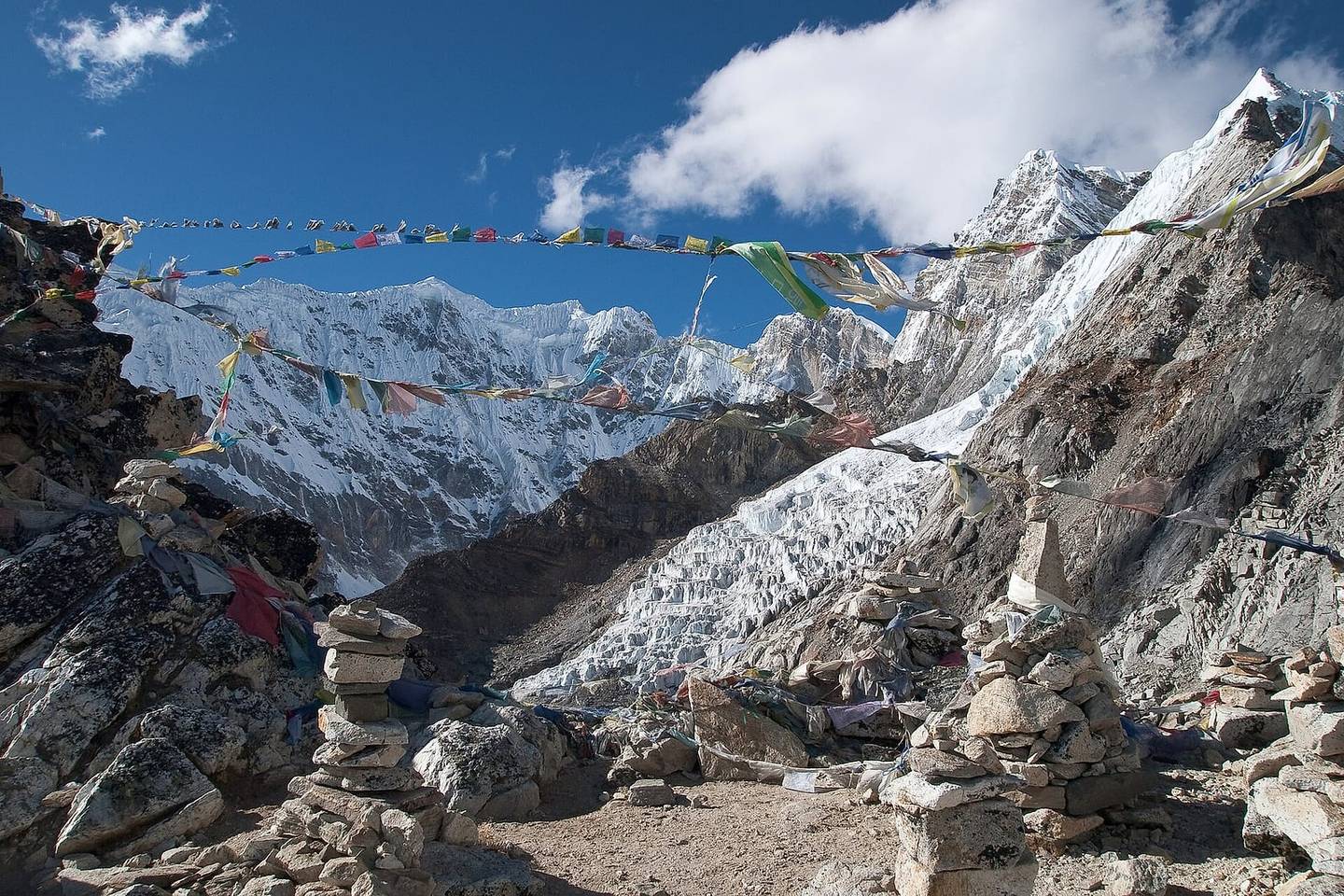
How high is it, and what is left to breathe?
Oxygen is 20.9% of the air at every height a helicopter reaches. What falls is the pressure: at 5,500 m one breath holds about half the oxygen it holds at the coast.
- Landing sites
- 18
- Highest, Kala Patthar
- 5,545 m
- Of a sea-level breath there
- 50%
Pick a landing site, see the air.
Ranked by height.
Highest first. Each figure is computed from the site's surveyed elevation against the standard atmosphere.
| Landing site | Elevation | Air pressure | Effective oxygen | Of a sea-level breath |
|---|---|---|---|---|
| Kala PattharNPKP · flights land or leave here | 5,545 m18,192 ft | 502 hPa | 10.4% | 50% |
| Tilicho LakeNPTL | 4,919 m16,138 ft | 546 hPa | 11.3% | 54% |
| Manaslu Base CampNPMB | 4,800 m15,748 ft | 555 hPa | 11.4% | 55% |
| GosaikundaNPGK · flights land or leave here | 4,380 m14,370 ft | 586 hPa | 12.1% | 58% |
| Annapurna Base CampNPAB · flights land or leave here | 4,130 m13,550 ft | 606 hPa | 12.5% | 60% |
| Kyanjin GompaNPKG · flights land or leave here | 3,870 m12,697 ft | 627 hPa | 12.9% | 62% |
| Hotel Everest ViewNPEV | 3,850 m12,631 ft | 629 hPa | 13% | 62% |
| Lo ManthangNPLM · flights land or leave here | 3,810 m12,500 ft | 632 hPa | 13% | 62% |
| Pathibhara TempleNPPT · flights land or leave here | 3,794 m12,447 ft | 633 hPa | 13.1% | 62% |
| SyangbocheVNSB | 3,748 m12,297 ft | 637 hPa | 13.1% | 63% |
| MuktinathNPMK · flights land or leave here | 3,710 m12,172 ft | 640 hPa | 13.2% | 63% |
| LuklaVNLK · flights land or leave here | 2,845 m9,334 ft | 715 hPa | 14.7% | 71% |
| JomsomVNJS | 2,736 m8,976 ft | 725 hPa | 15% | 72% |
| KathmanduVNKT · flights land or leave here | 1,338 m4,390 ft | 863 hPa | 17.8% | 85% |
| PokharaVNPK · flights land or leave here | 827 m2,712 ft | 918 hPa | 18.9% | 91% |
| TumlingtarVNTR | 401 m1,316 ft | 966 hPa | 19.9% | 95% |
| NepalgunjVNNG | 158 m518 ft | 994 hPa | 20.5% | 98% |
| BiratnagarVNVT | 75 m246 ft | 1,004 hPa | 20.7% | 99% |
Thin air, in plain figures.
The mixture does not thin
Oxygen is 20.9% of dry air at every height a helicopter reaches. What falls is the pressure, so each breath holds fewer molecules of everything, oxygen included.
The standard atmosphere
Pressure comes from the International Standard Atmosphere, the model aircraft performance charts are drawn against: (1 − 0.0000225577 × metres) to the power 5.25588. Temperature falls 6.5 °C per kilometre from 15 °C at sea level.
A model, not a forecast
The day’s weather moves the real pressure by a few per cent, and a clear Himalayan morning is routinely colder than the model. How a person copes with height is a question for a doctor.
The same thin air decides who can come. The payload planner works out how many of your party an aircraft can lift to a given helipad.
Altitude and oxygen, answered.
Is there less oxygen at high altitude, or is the air just thinner?
The air is thinner. Oxygen makes up 20.9% of dry air at every altitude a helicopter reaches. What falls is the pressure, so each breath contains fewer molecules of everything, oxygen included. At 5,500 m the pressure is about half what it is at sea level, so a breath holds about half the oxygen, which is the same as breathing roughly 10.5% oxygen at the coast.
How is the effective oxygen percentage at altitude calculated?
It is the oxygen fraction of air, 20.9%, multiplied by the air pressure at that height as a fraction of sea-level pressure. The pressure comes from the International Standard Atmosphere, the model every aircraft performance chart is drawn against: pressure falls as (1 − 0.0000225577 × height in metres) raised to the power 5.25588. The result is the oxygen percentage sea-level air would need to give you the same amount per breath.
Does flying to a high helipad affect you differently from trekking there?
The exposure is different in both length and speed. A helicopter reaches a Himalayan landing site in tens of minutes and is usually on the ground for well under an hour, where a trek takes days and sleeps at height. Neither is a statement about whether a particular person is affected. That depends on the person, and it is a question for a doctor rather than a calculator.
Do Nepali helicopter operators carry oxygen on board?
Yes, on high flights. Nepal's helicopter rules, which follow the international standard, require supplemental oxygen for every passenger on any flight above 13,000 ft (about 3,960 m), so an Everest landing flight carries it. You use it whenever you need it, and the crew will show you how. Tell the flight desk if anybody in your party has a heart or lung condition, and it will be part of how the flight is planned.
Why does altitude decide how many passengers a helicopter can carry?
Thinner air gives a rotor less to work with, so the aircraft's maximum weight falls as the landing site gets higher, and the empty aircraft and its fuel come out of that allowance first. A five-seat helicopter is often a two- or three-seat helicopter at a Himalayan helipad, whatever the cabin holds. That calculation is what the payload planner does.
The rest of the plan.
Each answers one question before you ask for a price. All free, no account needed.
Flight time and distance
Any two landing sites in Nepal: the straight-line distance, the time in the air, and whether the flight needs a fuel stop.
Payload planner
Your party's weights against a helipad's altitude — which helicopter types can lift you there, and how many of you can go at once.
Cost per person
Seats or the whole helicopter, priced against your headcount at published fares, with the party size where the two swap over.
Season calendar
Month by month, which flights are published as in season and how often that month's mornings are lost to cloud.
Evacuation reach
For before you trek: which helicopter bases can reach where you will be, how long the flying is, and the least it could cost.
Send the date. We do the comparing.
Tell the desk where, when and who is flying, including anyone who needs care at height. We ask every licensed operator that flies it and book you the cheapest, aiming to reply within four hours.